

Enough About "World Building".
World building is what they call your brand after the operation already won.

There’s a new gospel making the rounds, and if you’ve spent five minutes on LinkedIn or survived a single panel this year, you’ve been baptized in it whether you asked to be or not.
World building.
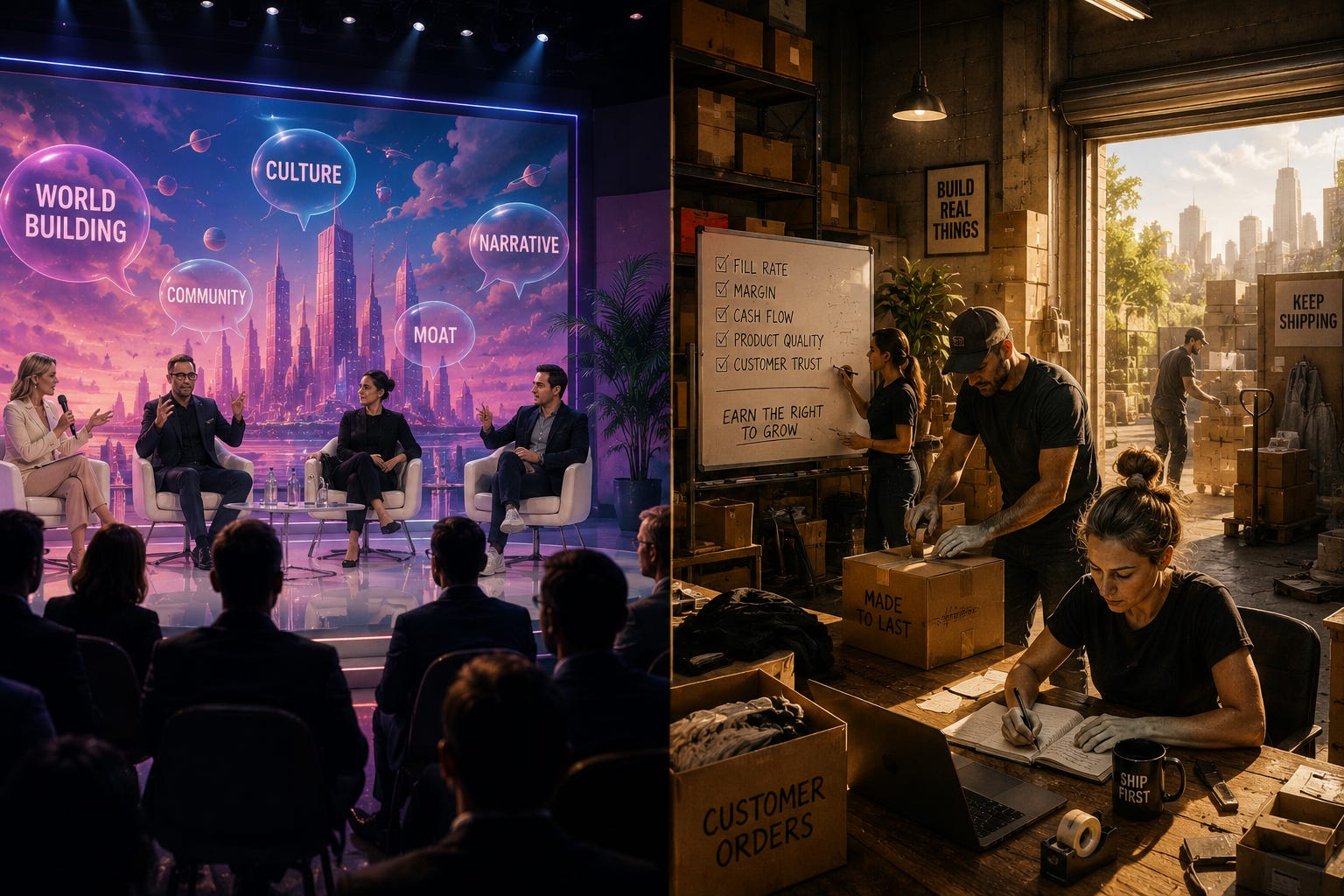
That’s the phase now. That’s the thing. That’s the ‘secret’ separating the brands that matter from the rest of us mouth-breathers still worried about boring stuff like whether the truck showed up. The theorists have spoken. Everybody line up and salute.
Let me tell you what they actually mean by it; in their words, so nobody can accuse me of building a strawman.
The trade press version: stop making campaigns, start building worlds. Sits at the glorious intersection of “community, culture and commerce.” One culture agency calls worldbuilding the literal future of brand building; a technique, they’ll tell you with a straight face, borrowed from novelists and film directors. The DTC growth boys have it down to a fortune cookie: brand-building is like world-building. And then the money people launder the whole thing into investor-speak, where it becomes a moat, “the real moat is brand,” they nod, defensibility that’s “not just marketing spend.”
It sounds profound. It sounds like the kind of thing you murmur “mmm, yes” at while you sip the conference coffee.
And it means almost nothing.
Here’s what the gospel gets exactly, perfectly, backwards: world building is downstream of operations. Not upstream of it.
The “world” everybody falls in love with; the universe, the aesthetic, the cult, the thing people want to live inside, that’s the visible ten percent of the iceberg. It only exists because somebody, somewhere, first solved the unglamorous machine underneath it. The co-man qualification. The landed margin. The fill rate. The cash conversion cycle that wakes up every morning trying to kill you. The chargeback you eat with a smile because the alternative is a delist. The PDQ that changes mid-production and detonates your timeline.
You cannot inhabit a world that’s out of stock. There is no cult around a brand that can’t keep product on the shelf. The world is what’s left over after the operation works. It is the exhaust, not the engine.
And notice, really notice, who is selling you this sermon.
It is, almost without exception, people who have never run the machine. Agencies who bill by the word. Investors reverse-engineering a tidy narrative onto the three brands out of three hundred that happened to win. Pundits. Consultants. People who’ve studied the loading dock from a great and comfortable distance and have never once had to stand on it at 6 a.m.
They look at a brand that already made it and they see the world. They don’t see the seven years of operational knife-fighting that earned the right to have a world at all. That part doesn’t sell a keynote. Problem is that it should, because that’s what the founders really need to know to build a lasting brand.
Here’s the part that actually makes me adgitated, and not on my own behalf.
Somewhere right now there’s a founder reading this stuff at eleven o’clock at night. She spent her whole day fighting a fill-rate problem and a vendor portal that hates her and a co-man who missed a run. And she scrolls past the eighteenth post about world building and she thinks: maybe that’s what I’m missing. Maybe I’m doing this wrong. Maybe I’m not visionary enough. Maybe I need to go build a world.
No, sweet friend. You just need to ship.
The world-building sermon is a category error that makes the best operators feel like frauds because they’re heads-down running an actual business instead of generating mood boards. It is the crab bucket wearing a TED badge. A status game dressed up as advice. And it’s costing good founders their confidence at exactly the moment they should be trusting their instincts.
Because the truth is the deeply unsexy one: everything has to fire on all cylinders. Brand is one cylinder. It matters. It matters a lot. But it cannot — cannot — compensate for a broken machine. A gorgeous, immersive, culturally-resonant world bolted onto a 60% fill rate is a dead brand walking. Meanwhile the plain little brand that ships every time, holds its margin, and never gets delisted? That one survives long enough to get interesting. That asymmetry is the entire game. The gospel pretends it doesn’t exist.
Now here’s where I’ll surprise the people who think this is just me being a grump.
I build worlds.
Our covenant. The 3,000 doors. The rebrand and campaigns. The whole canon I’ve been laying down in this very newsletter. I am, by any honest definition, guilty as charged.
So I’m not anti-world. I’m anti the sequencing lie.
I did not sit down eight years ago to “build a world.” I built a company. A real one, with a charter that gives the profits away by law, and product on three thousand actual shelves, and a husband doing the math at the kitchen table so the thing doesn’t tip over. The world is simply what all that realness radiates.
World building is a result. It is not a strategy. You don’t build the world and wait for the business to follow. You build the business; the boring, grinding, operational, keep-the-lights-on business, and the world is what comes off it like heat.
They have it backwards. They’ve always had it backwards.
And look, if you actually want to talk about innovation, I’m all in. Let’s talk. But let’s talk about a real one, something a person engineered, not a word people chant at each other from a stage.
Take Eric Ries’s Incorruptible — a book about building a company that structurally cannot be corrupted — and about the eight years I spent quietly building the working model of exactly that before it had a name. Holding company, licensing the IP down for a fee off the top line, profit covenanted out the door, governance I don’t control by design. Structure. Sequence. The order you have to pour the foundation. That is innovation. You can draw it on a whiteboard and a lawyer can actually execute it.
That’s the stuff worth a panel. So go find those founders, the ones building the machine instead of naming it. There are far more of us than the conference circuit lets on, and we are not hard to spot: we’re the tired ones who can tell you our fill rate to the decimal.
But for the love of God, stop with the buzzwords.
Peddle it somewhere else.
The operators are busy.
Thank you for saying this! I’ve long felt the world building POV places far more importance on the role a brand plays in a consumer’s life than reality would suggest